

Pink Azaleas
* on transformation *

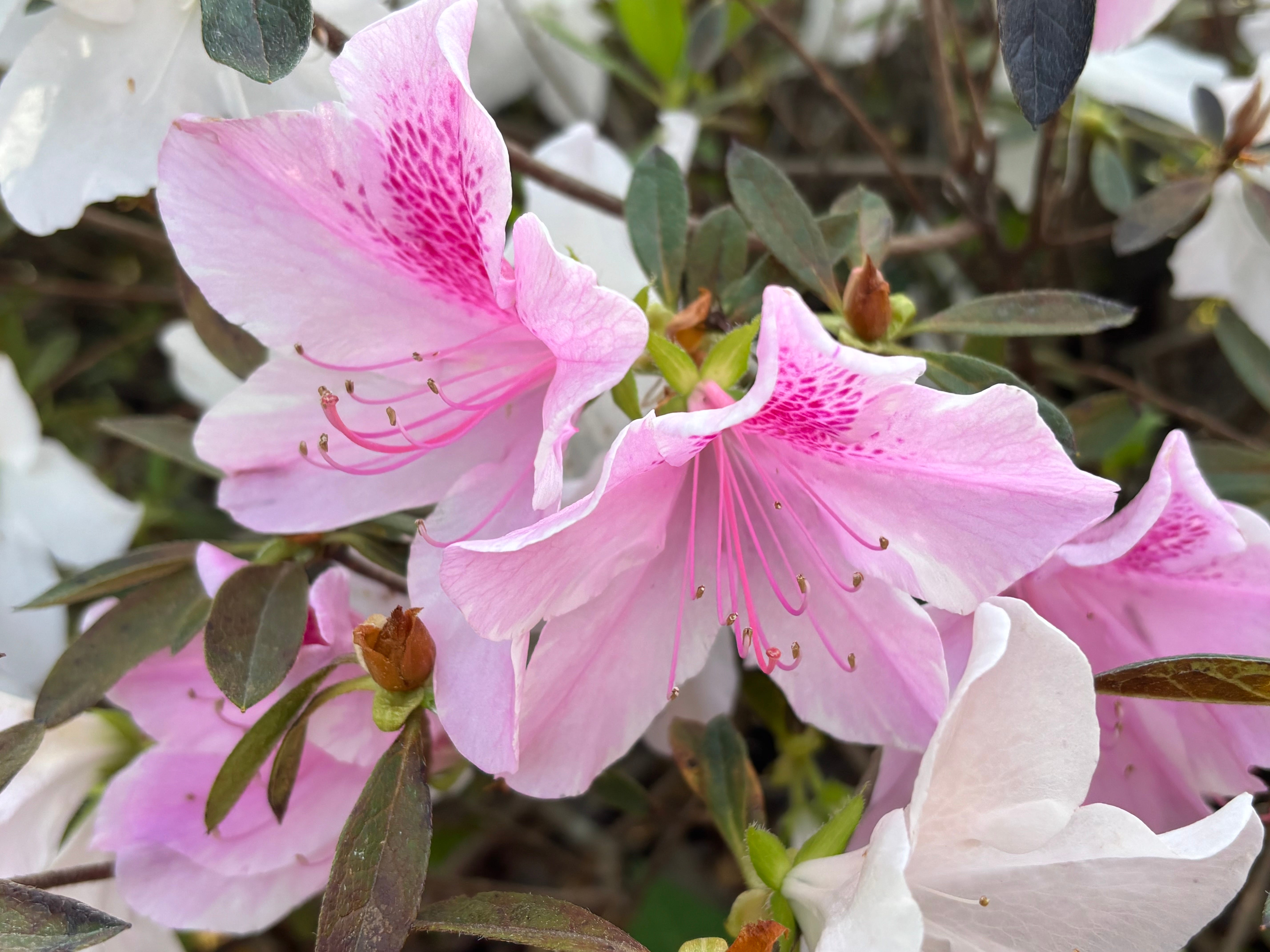
It’s been twenty-five years now since the azalea bushes were planted in front of our house. My mother chose them for their classic simplicity, their lush foliage, their easy flowering. And every spring since then, they have rewarded her choice with oversized white flowers that billow like clouds in the spring sky.
Until this year—when one section of the bush went completely rogue. The flowers on this stem of the plant were no longer white. Instead, they were indisputably pink.
If reading that made you do a double take, imagine what seeing it was like. The week of Easter, I was surveying all those white blooms with satisfaction when suddenly—what was that, down in the bottom corner of the bush? The blooms were the same shape, yet totally different in color. Their petals were watercolor cotton candy, a full-throated song from this already exquisite flower. The pink had visited each of the flowers differently; some had only a faint blush on the tips, while some were deep-dyed fuchsia with magenta speckles on top.
I laughed out loud at the sheer thrill of serendipity. I’m still not sure why these pink blossoms appeared after twenty-five years. Cross-pollination from the nearby red azaleas? A latent genetic quirk that took generations of flowers to manifest? Some odd environmental reaction? Who knows, and who cares. The flowers on that bush were transformed, and the transformation was beautiful indeed.
Transformation is a charged word that often seems to overpromise and underdeliver. When we hear it, we envision magician’s wands or instant incantations. But transformation is more messy than momentary.
That distinction is baked into the word itself. The prefix trans- holds the idea of something being literally “carried across” from one form to another. It’s not a snap of the fingers; it’s a slow slog toward the new.
Nature knows this secret, even if we don’t. At the same time I found the azalea flowers, I was watching the natural world undergoing its own hidden hardships of transformation. Tadpoles wriggle their way into tails and legs to become frogs. Trees circulate sap, pulling nutrients from secret water and simple sunlight as embryonic fruit swells at the tips of their branches. Caterpillars eat their way to bursting, then hang head-down, spin themselves into darkness, and literally dissolve themselves into a genetic soup that reconstitutes in butterfly form. The birth of something new is never bloodless.
The most complex scientific explanations can only hint at these natural wonders. And perhaps that is why the etymology of transformation carries a second implicit definition: a supernatural work. True transformation, so said the ancients, wasn’t the work of humans. It certainly wasn’t the inevitable last domino at the end of a long chain of material processes. In their worldview, it was instead something much less predictable, and more powerful, that turned tadpoles to frogs and caterpillars to butterflies and sunlight to apples and white flowers to pink ones. It was, they believed, the work of God.
And if we can seek for a supernatural spark in these natural processes, then certainly we can find it in a far greater miracle: the change in a human heart.
When I first told a family friend I had accepted a position at a substance abuse recovery center, she gave the kind of foggy sigh that instantly makes you second-guess the last thing you said. “And—do you like it?”
I assured her I did.
Another sigh. “Well, good. But—oh, that’s heartbreaking work.”
Heartbreaking work. Even now, I roll those words like a river rock in my pocket. Oh, I understand her point. In a vocation this complicated—mentally, procedurally, and spiritually—burnout is real. So is compassion fatigue—the desperate scraping of the bottom of your emotional barrel on a tough day. There’s a particular pain as you watch a client grapple with the consequences of their choices, or become overwhelmed by the work of recovery, or stagger out the door and into a relapse. And the pain is shadowed, always, by the dark wings of guilt. What could I have done differently? What could I have said? How could I have convinced them to stay, to fight, to live?
Yet in the end, isn’t all good work heartbreaking? There is an element of excrucior in everything that has a glimmer of the eternal. And while I believe in heartbreak, I believe in transformation more.
I work here because I know that transformation—that unwieldy, mysterious beast that’s both human intention and divine intervention—is real. I see clients struggle through trauma work, coming out on the other side with a new understanding of how what they experienced shaped what they did. I field their questions, about God and life and why those two have to be so hard to understand, and I watch them not walk away from the answers. I listen to their stories—so many stories—and I see the pieces they are holding with care, the ones they are desperate to put back together. Sure, I see some of them give up and walk back onto the unforgiving streets that will swallow them. But I see others sweat and cry and bleed and wrestle and swear and read and pray and work and keep going.
In other words, I see white flowers turn pink.
Right around the time I discovered those pink flowers, I was slammed with a succession of stressful events. As a result, my brain responded with its old, embedded defense mechanism, the one I thought I’d slowly unfolded myself from—turning inside out with anxiety. I entered a long, gray hallway of days when the sky cracked around me, my thoughts were soap-slippery with panic, and my mind melted down with every obsessive fear. I survived each day’s work by total disassociation, then sank into the evening shadows—dimmed with pain, yes, but also the stench of self-loathing. I thought I was stronger! I thought I knew better! I thought I was over this by now!
Yet in the midst of the flare of anxiety, I began to realize something: I was still breathing. The fear could cripple me but never kill me. There were even moments of fierce, wild joy, when the sun broke through the storm-howl of the soul, and I remembered all over again how temporary the clouds really were.
Years ago, anxiety had the power to wipe me into, quite literally, a life of death. But now, it’s different. It’s more like looking through a cloudy gray lens. Yes, my vision is obstructed, but I don’t forget how vibrant the real world on the other side is. And I can hold onto the truth of that even when my brain telling me something different.
Apparently, even if I can’t quite see it, something deep inside me is being transformed.
It’s not heartbreak I feel at the recovery center, at least not most days. It’s just a frustrating sense of total inadequacy. I look at the towering mountain of obstacles in front of our clients, the wall they have to scale to make their way to a new and happy life, and I feel as if any words I could offer would provide the barest scratch of a foothold. I stand before my class, and I see the same desperation written across their eyes: Please, tell us how to get over this wall.
And I wish I knew—for them, and for me, with my own fumblings toward a life that weighs less. I wish I had an easy formula. I wish I had a magic prayer. I wish I knew the recipe for spiritual TNT.
But instead, I take a deep breath, and I tell them what I do know. I tell them about a divine spark that breathes in the deepest places of our hearts, most likely before we know He is there. I tell them about the long, slow, painful, holy process of being carried over to our new forms. I tell them about frogs that emerge from puddles, about butterflies that creep out of cocoons, about white azaleas that turn pink like a wink from God.
Do you have any metal nearby them? I read that can make them change colors.