

Under the Aurora
* the Northern Lights, C. S. Lewis, and cosmology *

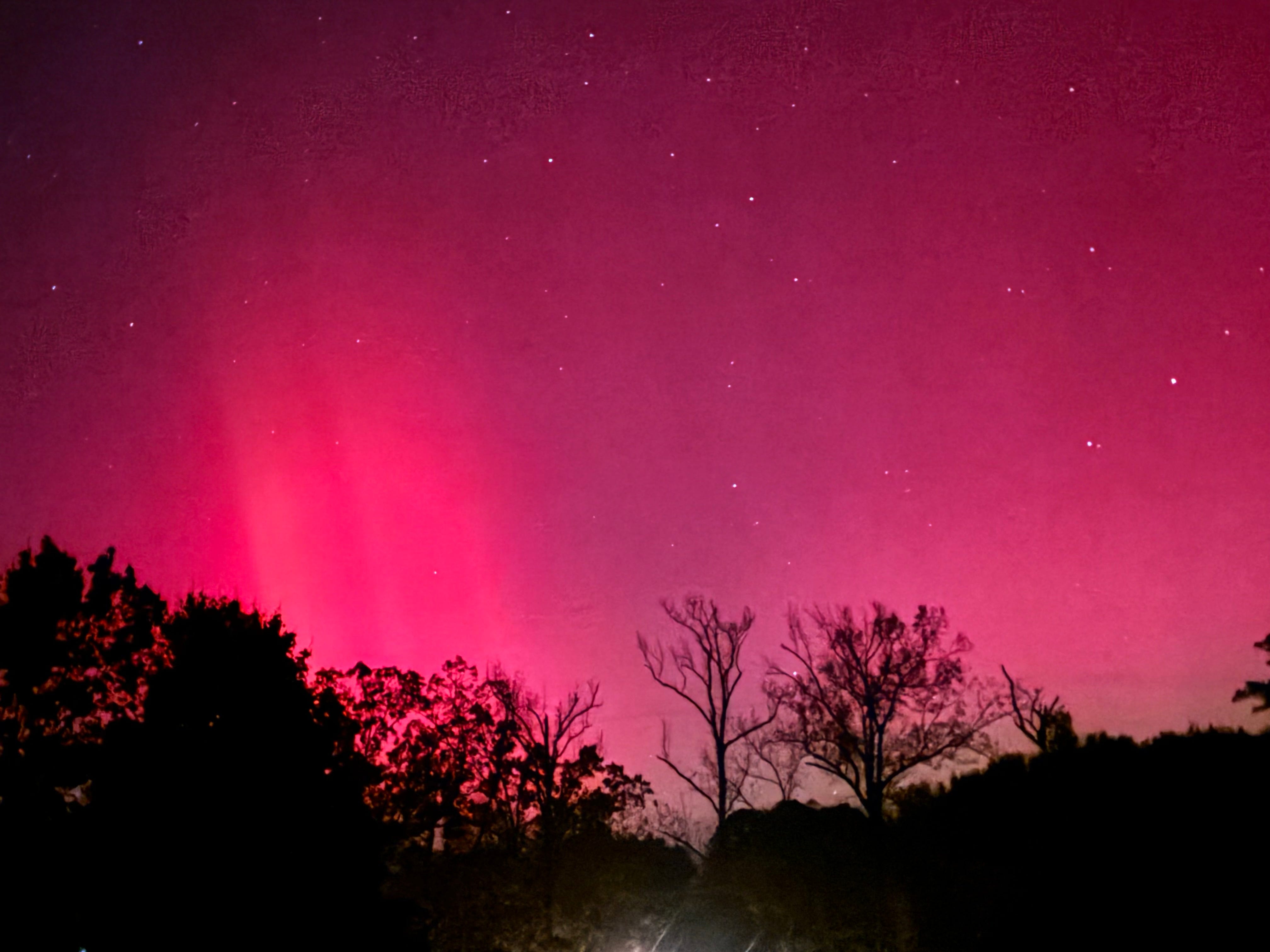
A quick note: this will be the last Wild Goose Words post of the year. As such, it includes both a poem and an essay (two for one, friends!) on my reaction to seeing the Northern Lights for the first time (in Arkansas! The irony is not lost on me).
Enjoy today’s post…and I’ll be back in a couple of weeks with a final Christmas surprise!
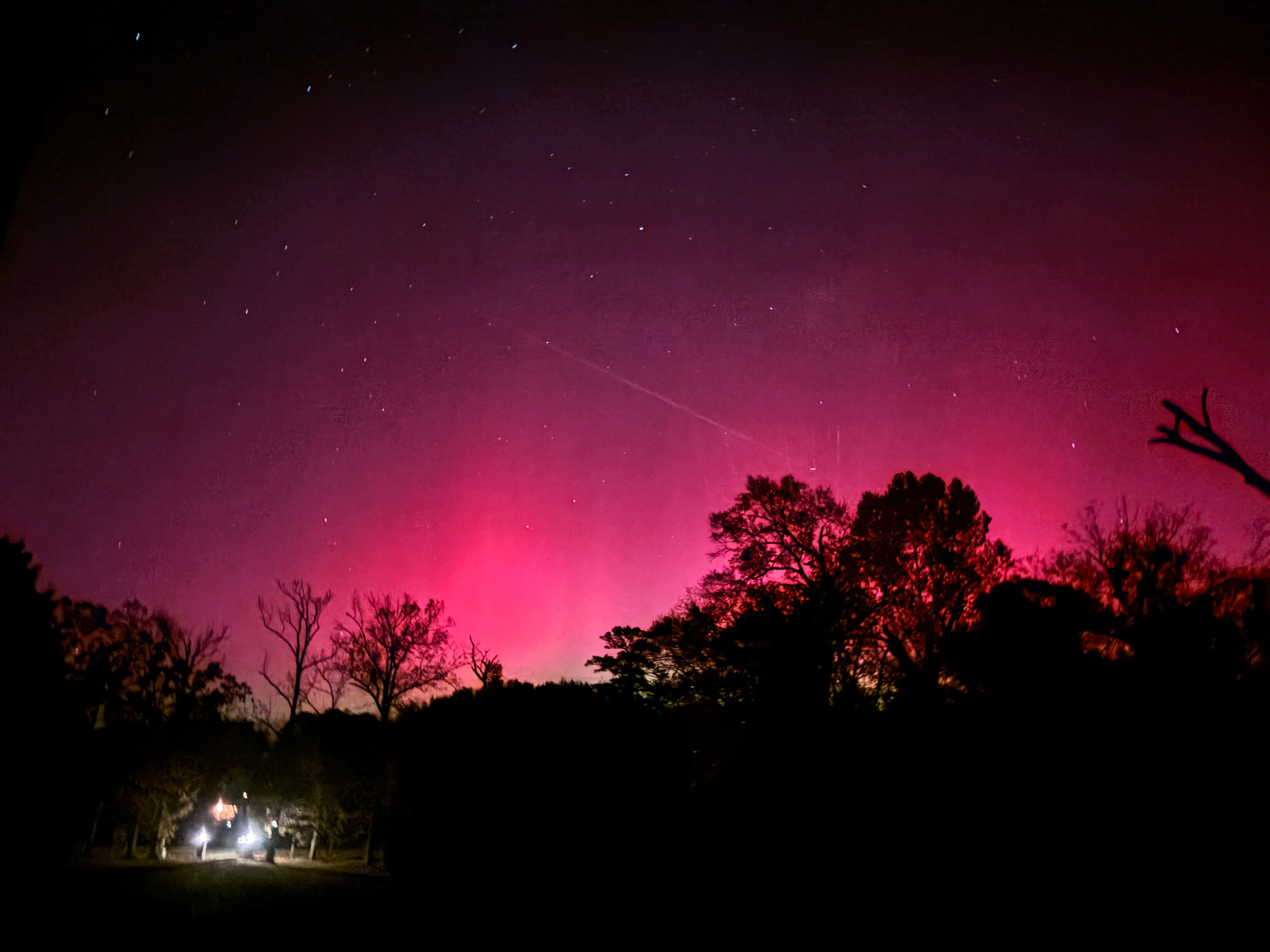
Last night the lights swept south. Solar friction
Struck a match on the atmosphere, magenta force-field-flames
Burnishing the bright edge of the dark,
Falling fire, a mighty rushing (electro-pneuma) wind.
Fierce as the song of the shooting stars, soft as the shadow of the moon,
Strong enough to undo unseeing, and catch my blind friend in the eyes.
What will we call this? Is it
Spirit-flicker, shield-shimmer of the earth-encircling guards?
Carriage for a heavenly wedding, fox-flung fire—or perhaps
The home-bringing hearth of an unforgetting God, brimming with
The birthing, and the dying, and the blessing in each one?
Ask the walkers of the old road. Then, the cosmos had a different color—
No formless and void of drained-out dark; say rather, a womb of wonder.
Our earthen lives, they said, are lived suburban. Farther than we think
To lift our eyes, the cosmos-city glows with heat, and light,
And power pulsing color through the sky,
And glory’s weighty wings above our heads,
And beauty that does not forget, but strikes the spark
To light our way back home—even here—
Where we, the blind and broken, strain to see
The light that’s pouring from the heavenlies.
A Few Thoughts…
It’s no exaggeration to say that the Northern Lights have always fascinated me. When I first learned of them as a small child, I was awestruck—colors that swam across dark skies, born of the sun and the air and the shifting magnetic-magic around the poles? The amazement of it simply added to my young wide-eyed wonder at the world, full of miracles that seemed to compound daily.
Fast-forward a couple of decades, and it now requires more practice for me to notice that innate miraculous (practice I constantly strive to pursue!). Yet some moments effortlessly reignite the sparks of that childlike wonder, and seeing the Northern Lights for the first time was absolutely one of those experiences.
The above poem is my attempt to capture the majesty of the moment and my homage to the many folkloric traditions surrounding the phenomenon (the last four lines of the first stanza are direct allusions to some of this colorful mythology). Yet it’s also my exploration of deeper questions.
Cosmology is one of these matters. Our modern scientific view, in its severely reductionistic approach, is a sharp departure from the views of nearly every other historic people group. More dangerously, however, it is a subtle return to philosophical, if not literal, geocentrism. The voice of modern despair trains us to see our planet as the epicenter of all things, with the rest of the universe dismissed as blank, uninhabitable blackness. Paradoxically, however, it simultaneously preaches that we are unutterably insignificant on a galactic scale. Therefore, so this logic goes, we can neither expect nor deserve help or hope from outside ourselves. Earth is lost in a yawning void.
However, watching the lights couldn’t help but remind me of a different view—that presented by C. S. Lewis in his classic Out of the Silent Planet. In this masterful work, Lewis’s protagonist Ransom takes a journey to space…and finds it not at all as he might have expected. Instead of blank emptiness, he’s met with a “tyranny of heat and light.” Lewis describes the surroundings further:
Both [heat and light] were present in a degree which would have been intolerable on Earth, but each had a new quality. The light was paler than any light of comparable intensity that he had ever seen; it was not pure white but the palest of all imaginable golds, and it cast shadows as sharp as a floodlight. The heat, utterly free from moisture, seemed to knead and stroke the skin like a gigantic masseur: it produced no tendency to drowsiness: rather, intense alacrity. His headache was gone: he felt vigilant, courageous and magnanimous as he had seldom felt on Earth. Gradually he dared to raise his eyes to the skylight. Steel shutters were drawn across all but a chink of the glass, and that chink was covered with blinds of some heavy and dark material; but still it was too bright to look at.
As Ransom becomes more accustomed to his surroundings, he finds that he can marvel at, and even love, the light:
He found it night by night more difficult to disbelieve in old astrology: almost he felt, wholly he imagined, ‘sweet influence’ pouring or even stabbing into his surrendered body….There, totally immersed in a bath of pure ethereal colour and of unrelenting though unwounding brightness, stretched his full length and with eyes half closed in the strange chariot that bore them, faintly quivering, through depth after depth of tranquillity far above the reach of night, he felt his body and mind daily rubbed and scoured and filled with new vitality.
But most interesting of all, Ransom’s adventures change not only his physical perception, but his worldview as well:
A nightmare, long engendered in the modern mind by the mythology that follows in the wake of science, was falling off him. He had read of ‘Space’: at the back of his thinking for years had lurked the dismal fancy of the black, cold vacuity, the utter deadness, which was supposed to separate the worlds. He had not known how much it affected him till now—now that the very name ‘Space’ seemed a blasphemous libel for this empyrean ocean of radiance in which they swam. He could not call it ‘dead’; he felt life pouring into him from it every moment. How indeed should it be otherwise, since out of this ocean the worlds and all their life had come? He had thought it barren: he saw now that it was the womb of worlds, whose blazing and innumerable offspring looked down nightly even upon the earth with so many eyes—and here, with how many more! No: Space was the wrong name. Older thinkers had been wiser when they named it simply the heavens—the heavens which declared the glory.
The womb of worlds—the heavens which declared the glory? How very different from our modern preconceptions. But Lewis’s world building here, though certainly creative, is by no means novel. Ever delighted and inspired by medieval scholars, he draws this concept from their cosmological constructions. In the medieval cosmic imagination, Earth was a frontier, and space—what was much more poetically termed the heavens—was a bright and blissful place, full of singing stars and wondrous glory and planets that knew every step of their dance. The medievals would agree with the moderns that Earth is an island—but to them, it is an island swimming in a sea of sheer wonder.
Imaginative? Idealistic? Perhaps. Lewis himself acknowledged the scientific limitations of these models, yet he also argued passionately that their marriage of philosophy, theology, and science was always intended to convey much more nuanced concepts than mere astronomical observations. And to Lewis, they were at the very least far less unrealistic than sheer reductive materialism—because they showed, however faultily, the knowledge of a truth beyond this world.
But all of these cosmological questions coalesced for me into something much more personal. Watching the aurora, I found it impossible to wear my twenty-first-century armor against what humans have always known—that salvation comes from outside us. We can look for answers around, or within, or behind, or ahead. Yet I believe that everything true will always come from the one place we forget to look—above.
This concept came home for me when an author friend (hey, Erin!) expressed her hope that her blind husband would be able to experience the aurora with her; she believed the light was strong enough to activate his remaining retinal sensitivity. It was a beautiful consideration, and it made me wonder—aren’t we all blind in our own ways, simply because we’re human? And aren’t we all waiting for light strong enough to break our darkness and call us back where we belong?
Watching the aurora, letting the colors wash over me, I knew that our world is not only more layered than we believe—it is more personal. We are not condemned to float in an abyss; we are invited to enter into a dance. And as we begin the season of Advent, I’m reminded all over again that the Light has come, and is coming, and will come again. We are not forgotten. So when the sky is on fire, let it summon us home.
All my musings are always free, but if you enjoyed this post and would like to “buy me a coffee” (basically a virtual tip jar), you can do so here!
Also, much of my inspiration for this post comes from this excellent book: The Medieval Mind of C. S. Lewis. I highly recommend for anyone interested in medieval cosmology and science, as well as how the philosophy of the time period influenced Lewis in his life and writing.
I love this! I haven’t been on Substack as much lately so it took me until now to read it. But I love the wonder and the hope here. Lately I have been reminded that what I need can’t be found in myself or anyone else. What I really long for is the One who is wiser and stronger than me and so beautiful and good.
Love this, Ashlyn!